

Which Conduit to Use for Exterior Camera Runs
Any camera cable that runs exposed outdoors needs protection, and conduit is how you give it. Sun, rain, temperature swings, lawn equipment, gnawing rodents, and a determined burglar are all threats to a bare cable, and conduit defends against every one of them. But “use conduit” isn’t the whole answer — the real question is which conduit, and that depends on the run.
Here’s the short version of how we choose. Rigid metal conduit is our default for every exterior run — it stays rigid without sagging, survives years of sun and weather, and it’s the strongest deterrent short of hiding the cable entirely. PVC we don’t recommend above grade: it needs closer hanger spacing than people install, turns brittle in the elements over time, and is easier to get through — though it’s the right call underground or for general electrical. This guide walks through both, how to handle a run to a detached garage or barn, and the burial and weatherproofing details that separate a run that lasts fifteen years from one that fails in two.
This is the deep dive that our broader cable management guide points to. If you’re routing the cable into a wall at either end, also see our guide on running camera cable through walls and attics.
Why Bare Cable Outdoors Fails
When to Use Conduit for Outdoor Security Camera Wiring
Even outdoor-rated cable has a finite life when fully exposed. UV light breaks down the jacket until it cracks and crumbles, usually within a few years on a south-facing run. Wind fatigues unsupported spans. Squirrels and rodents chew jacket and conductors. And an exposed cable is the first thing an intruder reaches for — cut the line and the camera goes dark. Conduit solves all of this, and it makes the install look deliberate and professional instead of slapped together. Exposed, flapping cable is exactly the kind of detail that screams amateur; conduit is an easy way to look like a pro.
Conduit Types for Camera Runs
Rigid Metal Conduit — The Standard for Exterior Runs
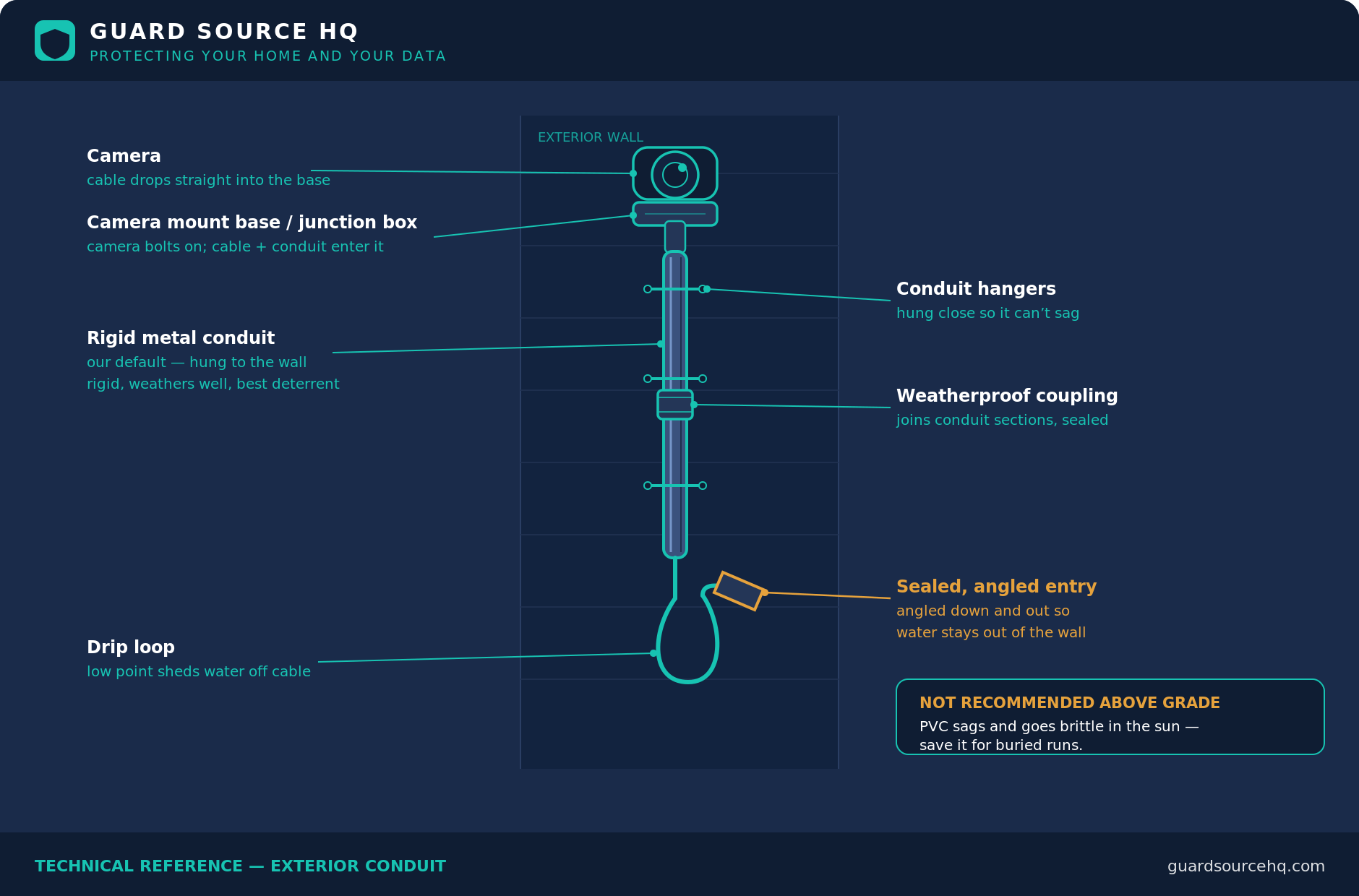
Rigid metal conduit is the strongest option and our standard for exterior camera runs, for three reasons. It’s genuinely rigid, so it spans between hangers without sagging — where PVC needs its hangers spaced much closer than people ever actually install. It shrugs off the elements: it won’t go brittle in years of sun the way plastic does. And it’s the strongest deterrent — a determined burglar can still get through it, but it turns a quick grab-and-cut into real work, and most won’t bother. Use weatherproof, watertight fittings outdoors, and note that in coastal salt air even metal can corrode — use appropriately rated or coated conduit there. Bond and ground exterior metal conduit per code. On any exposed or reachable run, rigid metal is what we reach for first.
PVC Conduit — Not Recommended for Exterior Runs
Rigid gray PVC is the low-cost choice for exterior low-voltage work, and for general electrical it’s a legitimate material. For an exterior camera run, we don’t recommend it, for three practical reasons. First, support: PVC isn’t rigid, so it needs its hangers spaced far closer than metal — and in the field almost nobody installs enough, so exposed PVC sags between hangers and strains its fittings. Second, weathering: it’s sold as UV-resistant, but resistant isn’t proof — years of sun and temperature swings still make it brittle, and brittle conduit cracks. Third, it’s a weaker deterrent — it’s easier to get through than metal. The one exception is underground: a buried run is held by the soil, out of the sun, and out of reach, so direct-burial-rated conduit (often PVC) is the right call below grade. Above ground, run rigid metal.
Mounting Conduit Along a Wall
The most common exterior scenario: conduit running along a wall or under a soffit from the camera to the point where the cable enters the building.
Plan the Path
Route the conduit as directly as the wall allows, and keep bends to gentle sweeps rather than tight corners so you can pull cable through without snagging or violating bend radius. A clean, direct path is easier to pull, easier to secure, and looks intentional.
Secure with Hangers
Mount the conduit with proper conduit hangers into solid backing — studs, framing, or masonry anchors, not bare siding. Space the hangers close enough that the run stays rigid and doesn’t sag or rattle in the wind. This is exactly where PVC gets people into trouble: it needs its hangers spaced closer than metal, and a run that looked fine on install day sags once the plastic warms and works.
Seal the Entry
Where the conduit meets the wall penetration, seal thoroughly with exterior silicone, and angle the penetration slightly downward to the outside so water can’t track back into the wall. Leave a drip loop in the cable before it enters if any cable is exposed between the conduit and the wall.
Running Conduit to a Detached Garage, Barn, or Outbuilding
This is where conduit really matters, and where you’ll often be burying it. Reaching a detached structure usually means a buried run across a yard.
Burial Depth
For low-voltage cable in conduit, bury the conduit deep enough to clear normal yard activity — a common practical depth is 12 to 18 inches, deeper if you’ll ever dig or till above it. Check local code, but low-voltage isn’t held to the same depths as line-voltage power. The goal is to get below the reach of a shovel, an aerator, and frost heave.
Use Direct-Burial-Rated Components
Underground is where PVC earns its keep: a buried run is supported by the soil and out of the weather, so its support and UV weaknesses don’t apply. Use conduit and fittings rated for burial, and glue every PVC joint (or properly couple every metal joint) so groundwater can’t seep in. Even better, pull direct-burial-rated cable through the conduit as a belt-and-suspenders measure — if the conduit ever cracks or floods, burial-rated cable survives contact with water far better than standard cable.
Mind the Distance Limit
Runs to outbuildings are where PoE distance becomes a real concern. The 328-foot (100-meter) limit for PoE over copper is easy to exceed on a long property. If your run is close to or past that, read our guide on PoE cameras for barns and outbuildings — you may need a PoE extender, a switch at the outbuilding, or a fiber-plus-media-converter solution.
Add a Pull String
When you lay conduit, pull a length of mason’s line or pull tape through it before you ever need it, and leave it in place. The day you want to add a second camera or replace a damaged cable, that string turns a dig-it-all-up nightmare into a five-minute pull.
Common Exterior Conduit Mistakes
- Using PVC on an above-ground run. It sags without close hanger spacing, goes brittle in the sun, and is easier to get through — run rigid metal above grade and save PVC for buried runs.
- Under-hanging the run. Space hangers close enough that the conduit stays rigid and doesn’t sag — closer still if you ever do use plastic.
- Tight 90-degree corners. Use long sweeps so you can pull cable and protect bend radius.
- Burying too shallow. Get below shovels, aerators, and frost. 12–18 inches is a common target — check local code.
- Unglued or uncoupled buried joints. Seal every joint on a buried run so groundwater stays out.
- No pull string left behind. Always leave a pull line for the next cable.
The Bottom Line
Conduit is what makes an exterior run last — and on a security system, it’s also your best deterrent. Run rigid metal on every exposed run: it stays put where PVC sags, survives the sun where PVC turns brittle, and it makes reaching the cable real work. Save PVC for buried runs. Use weather-tight conduit and fittings, bury detached-building runs deep with sealed joints and burial-rated cable, and always leave a pull string behind. Get this right and your exterior cable is protected from sun, weather, rodents, and tampering alike — the kind of install that quietly works for fifteen years.
Once your cable is protected and run, make sure each camera is aimed for maximum coverage — see our camera placement guide.
Frequently Asked Questions
What kind of conduit is best for outdoor security camera cable?
Rigid metal conduit, for any exterior camera run. It resists impact, stays rigid without sagging, holds up in the weather without going brittle, and it’s the strongest deterrent — a burglar can still get through it, but it’s far more work than plastic. We don’t recommend PVC above grade, since it needs closer hanger spacing than people install and degrades in the sun, though it’s fine underground or for general electrical.
Is PVC conduit good enough for camera cable outdoors?
For an exterior camera run, we don’t recommend it. PVC needs closer hanger spacing than most installs give it, so it sags; it’s UV-resistant but not UV-proof, so it goes brittle over years; and it’s a weaker deterrent than metal. It’s fine for general electrical or a fully buried run out of the weather — but above ground, use rigid metal.
How deep should I bury conduit for a camera run to an outbuilding?
A common practical depth for low-voltage conduit is 12 to 18 inches — deep enough to clear a shovel, an aerator, and frost heave. Go deeper if you’ll ever dig or till above it, and always check local code before you trench.
Should I leave a pull string in the conduit?
Yes. Pull a length of mason’s line or pull tape through the conduit when you install it and leave it in place. It turns adding or replacing a cable later into a quick pull instead of a dig-up-the-yard project.
Who runs Guard Source HQ
Guard Source HQ grew out of problems I’ve spent years solving for myself, friends, and family. I’ve moved five times, set up all kinds of security camera systems, and helped friends and family install and troubleshoot theirs. I’ve had my own router compromised through a smart device, and people now come to me or get sent my way when something online doesn’t look right or after they’ve been scammed. I built Guard Source HQ to turn what I’ve learned from solving those problems into guides and tools regular people can use.
Need help with something I haven’t covered? Ask a question or suggest a topic.
Related: Running 12V DC cameras through that conduit? On copper, long runs lose voltage before the camera sees it — size the wire with our 12V camera voltage-drop guide.