
How to Run outdoor rated Ethernet Cable for Security Cameras
Running Ethernet outdoors is not the same job as running it inside your walls, and using the wrong cable is one of the most common mistakes on DIY camera installs. The riser cable from the home-improvement store works great inside the house and fails fast outside it. This guide covers what “outdoor rated” actually means, how to choose the right cable, and how to run it so it survives sun, weather, and time. If you’re planning the physical path first, pair this with our guides on running cable through walls and attics and conduit for exterior camera runs.
Why Indoor Cable Fails Outdoors
Standard indoor Ethernet — the CMR (riser) or CMP (plenum) cable sold for in-wall use — is built for a climate-controlled environment. Put it outside and three things attack it. UV light breaks down the jacket until it cracks and crumbles, often within a couple of years on a sun-exposed run. Water wicks into the cable and degrades the conductors and the signal. And temperature swings make the jacket brittle. The cable might work fine for a season, then start dropping your camera offline as the jacket fails and moisture creeps in. If you’re chasing a camera that worked at first and then went flaky, jacket failure on an outdoor run is a prime suspect — our guide on cameras that keep going offline covers the full diagnostic path.
Understanding Cable Ratings
The jacket rating, printed right on the cable, tells you where it’s allowed to go. Knowing these saves you from buying the wrong box.
CMR (Riser)
Riser-rated cable is for indoor vertical runs between floors. It’s the common blue box at the store. Fine inside your walls and attic — not for outdoor exposure.
CMX (Outdoor)
CMX is rated for outdoor use, with a UV-resistant jacket built to survive sun and weather. This is the minimum you want for any cable exposed to the elements.
Direct Burial
Direct-burial cable goes a step further with a heavier, waterproof jacket (often gel-filled or with a waterproof tape layer) designed to be buried in the ground without conduit. If you’re trenching out to a detached garage or barn, this is what you want — though running even burial-rated cable inside conduit is the belt-and-suspenders approach the pros use.
Shielded vs. Unshielded
For most residential runs, standard unshielded cable is fine. Shielded cable (STP) adds a foil or braid layer that helps in high-interference environments — running parallel to power lines, near large motors, or industrial settings. For a typical home it’s usually unnecessary, but it doesn’t hurt on a long exterior run near electrical service.
Choosing the Right Outdoor Cable
A few specs matter when you pick a box for an outdoor camera run.
Solid Copper, Not Copper-Clad Aluminum (CCA)
This is the big one. Cheap cable is often CCA — copper-clad aluminum — which is a deal-breaker for PoE. Aluminum has higher resistance than copper, which means more voltage drop and more heat over a PoE run, and it can underpower your cameras on longer runs or even become a fire risk. Insist on solid bare copper conductors. The box will say so; if it doesn’t clearly state pure copper, assume CCA and skip it.
Cat5e vs. Cat6 for Outdoor Runs
For security cameras, Cat5e is genuinely sufficient — even 4K cameras don’t saturate it, and PoE runs identically on both. Cat6 buys you headroom for higher bandwidth and longer-distance gigabit, and it’s not much more expensive, so it’s a reasonable default. The deciding factor outdoors is the jacket rating, not the category — a CMX-rated Cat5e beats a riser-rated Cat6 for an exposed run every time.
Mind the Distance Limit
PoE over copper has a hard ceiling of 328 feet (100 meters) for the combined run. Outdoor runs to outbuildings are where this becomes a real concern. If your run is long, read our guide on PoE cameras for barns and outbuildings before you buy.
Running the Cable Outdoors
Even with the right cable, how you run it determines how long it lasts.
Use Conduit for Exposed Runs
The best outdoor cable still benefits from conduit on any run exposed to direct sun or physical damage. Conduit extends the cable’s life dramatically and protects against rodents and cutters. We cover this fully in our conduit for exterior camera runs guide. At minimum, even CMX cable on a long sunny south wall lasts far longer inside a length of conduit.
Angle Penetrations Downward
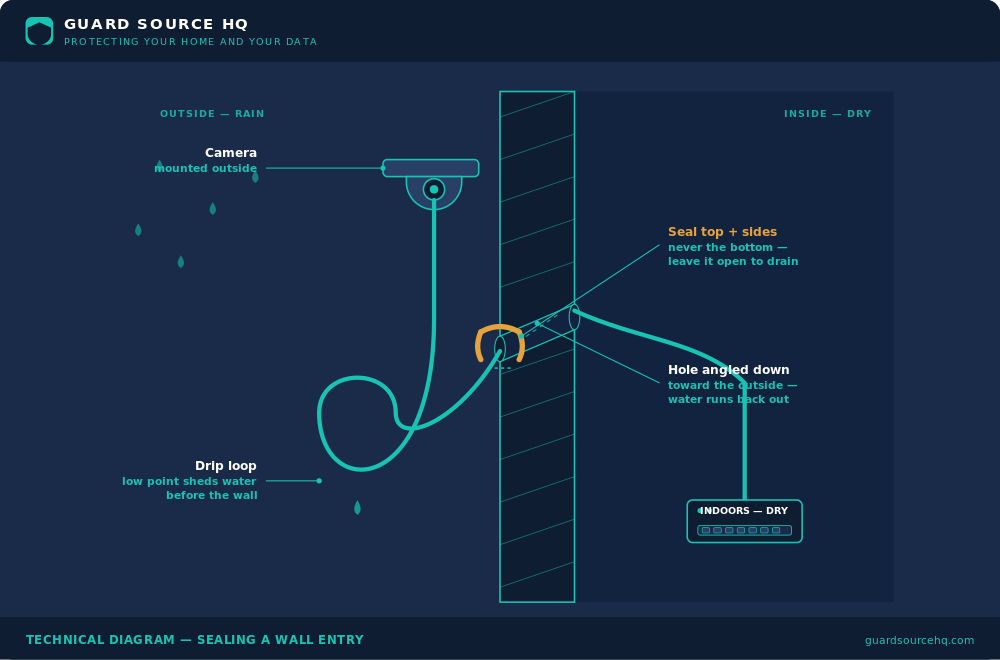
Wherever the cable passes through an exterior wall, drill the hole angled slightly downward to the outside so water can’t run back along the cable into the wall. Seal the penetration with exterior silicone or a cable gland.
Leave a Drip Loop
Before the cable enters any wall or connection, leave a downward loop so water drips off at the low point instead of tracking inward. It’s free and it prevents a huge share of water-intrusion problems.
Secure Without Crushing
Support the cable every few feet with insulated staples or UV-rated cable clips so wind can’t fatigue an unsupported span. Never drive a fastener tight enough to deform the jacket — crushing the cable damages the pairs inside and degrades performance.
Keep Your Distance From Power
Run parallel to electrical lines with a few inches of separation, and where you must cross AC power, cross at a 90-degree angle to minimize interference bleeding into your video.
Terminating Outdoor Cable
Outdoor terminations need protection. Any RJ45 connection exposed to weather should live inside a weatherproof junction box, sealed with the camera’s waterproof cap kit or self-amalgamating tape. We cover this in depth in our guide on weatherproof junction boxes and connectors. Never leave a bare connector exposed — that’s the single most common point of failure on an outdoor run.
Common Outdoor Cable Mistakes
- Using indoor (riser) cable outside. It fails to UV and water. Use CMX or direct-burial rated cable.
- Buying CCA cable. Copper-clad aluminum underpowers PoE and risks heat. Insist on solid bare copper.
- Skipping conduit on sunny runs. Even outdoor cable lasts far longer protected from direct UV.
- No drip loop or downward penetration. Water tracks into the wall. Loop the cable and angle the hole down.
- Exposed connectors. Seal every termination in a weatherproof box.
- Crushing the cable with tight fasteners. Snug, never deformed.
The Bottom Line
Outdoor Ethernet comes down to two things: the right cable and the right run. Use CMX or direct-burial rated cable with solid copper conductors — never indoor riser cable, never CCA — and protect it with conduit, downward-angled sealed penetrations, drip loops, and weatherproof terminations. Get the cable right and the run right, and your outdoor camera lines will outlast everything else in the system. Cut the corner on either, and you’ll be back up the ladder chasing dropouts in a year.
Ready to protect that run? See our full guide on conduit for exterior camera runs.
Frequently Asked Questions
Do I really need outdoor rated Ethernet cable for cameras?
Yes for any exterior run. Indoor riser cable degrades in UV and moisture within a couple of years, then starts dropping the camera offline. outdoor rated (CMX) or direct-burial cable is built to survive sun and weather, and conduit adds another layer of protection.
What’s the difference between CMX and direct-burial cable?
CMX has a UV-resistant jacket for above-ground outdoor exposure — the minimum for any run exposed to the elements. Direct-burial cable adds a heavier, waterproof jacket (often gel-filled) so it can be buried in the ground without conduit, which is what you want when trenching to a detached building.
Is copper-clad aluminum (CCA) cable okay for PoE cameras?
No. Aluminum has higher resistance than copper, causing more voltage drop and heat over a PoE run — it can underpower cameras on longer runs or even become a fire risk. Insist on solid bare copper conductors; if the box doesn’t clearly say pure copper, assume it’s CCA and skip it.
Should I use Cat5e or Cat6 for an outdoor camera run?
Cat5e is genuinely sufficient for cameras — even 4K doesn’t saturate it and PoE runs identically on both — but Cat6 is a reasonable default for a little headroom. Outdoors, the jacket rating matters more than the category: a CMX-rated Cat5e beats a riser-rated Cat6 on an exposed run every time.
How far can I run Ethernet for a PoE camera?
PoE over copper has a hard limit of 328 feet (100 meters) for the combined power-and-data run. Most homes never come close, but long runs to barns or outbuildings can exceed it — you’ll need a PoE extender, a switch partway, or a fiber-plus-media-converter solution.
Who runs Guard Source HQ
Guard Source HQ grew out of problems I’ve spent years solving for myself, friends, and family. I’ve moved five times, set up all kinds of security camera systems, and helped friends and family install and troubleshoot theirs. I’ve had my own router compromised through a smart device, and people now come to me or get sent my way when something online doesn’t look right or after they’ve been scammed. I built Guard Source HQ to turn what I’ve learned from solving those problems into guides and tools regular people can use.
Need help with something I haven’t covered? Ask a question or suggest a topic.