
Floodlight cameras have exploded in popularity, and for good reason — a bright light that snaps on when someone approaches is a genuine deterrent, and pairing it with a camera makes intuitive sense. But they’re not the right tool for every spot, and a standard camera is the better choice more often than the marketing suggests. This guide breaks down what each does well, where each belongs, and how to decide which to put where, so you build coverage that actually works instead of just buying the flashiest option for every corner.
Placement is half the battle with either type, so pair this with our guide on how high to mount security cameras.
What a Floodlight Camera Is
Floodlight Camera vs Standard Camera: Key Differences
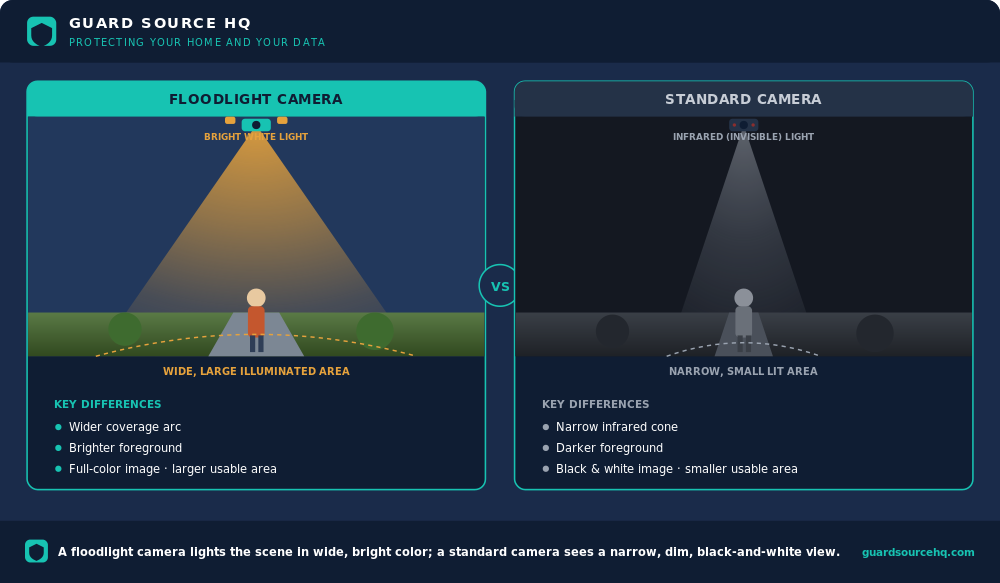
A floodlight camera combines a security camera with bright LED floodlights, usually triggered by motion. When something moves in range, the lights blast on and the camera records the now well-lit scene. The pitch is three benefits in one: deterrence (the sudden light startles and discourages), visibility (a brightly lit color image instead of grainy night vision), and convenience (security lighting and a camera in a single device).
What a Standard Camera Does Differently
A standard security camera records continuously or on motion, and at night it relies on infrared (IR) illumination to see in the dark, producing a black-and-white night image. It’s discreet, it doesn’t light up your property, and it’s typically smaller, cheaper, and easier to place. The trade-off is that without a floodlight, your night footage is IR black-and-white rather than full color, and there’s no active light-based deterrent.
The Real Strengths of Each
Where Floodlight Cameras Win
- Active deterrence. The sudden bright light is a real psychological deterrent in a way a small camera isn’t. Many intruders leave the moment they’re lit up.
- Color night footage. A lit scene gives you full-color detail — clothing colors, vehicle colors, faces — that IR black-and-white can’t match. This matters a lot for identification.
- Doubling as useful lighting. A floodlight cam over a driveway or back patio provides genuinely useful illumination, not just security.
- Wide coverage of an open area. Driveways, backyards, and large open approaches are where floodlights shine, literally.
Where Standard Cameras Win
- Discreet surveillance. Sometimes you want to capture what’s happening without announcing the camera or lighting up the scene. A floodlight tells someone exactly where the camera is — and where to avoid.
- Tight or numerous placements. You can put standard cameras in more spots, more cheaply, and cover more angles. Building overlapping coverage with floodlight cams everywhere gets expensive and creates a lot of light pollution.
- Areas that are already lit. If a spot has existing lighting, a floodlight is redundant — a standard camera captures fine and costs less.
- Avoiding nuisance triggers and neighbor friction. Floodlights that fire all night at passing cats, cars, and wind annoy you and your neighbors. A standard camera records without lighting up the block.
- Indoor use. Floodlights are an outdoor tool. Inside, you want standard cameras.
How to Decide Which Goes Where
The smart approach isn’t one or the other — it’s using each where it fits. Here’s how to think about a typical property.
Use a Floodlight Camera For:
Your primary deterrence points and large open areas — the main driveway, the back patio or yard, the dark side of the house an intruder would target. These are spots where active light adds real deterrence and where color night footage of an approaching person or vehicle is most valuable. One or two well-placed floodlight cameras covering the obvious approach points do a lot of work.
Use Standard Cameras For:
Everything else — secondary entry points, tighter spaces, spots where you want discreet coverage, areas that are already lit, and any indoor locations. Standard cameras fill in the comprehensive coverage around your floodlight anchors, including watching the approaches to your floodlight cameras themselves so a clever intruder can’t simply avoid the lit zones.
Practical Considerations
Power and Wiring
Floodlight cameras draw more power than a standard PoE camera because of the lights. Many floodlight models are wired to mains power (like replacing an existing fixture) rather than running on PoE, which changes your installation. A standard PoE camera gets power and data over one Ethernet cable; a mains-powered floodlight needs an electrical connection. Factor this into your install — see our guide on weatherproofing and sealing outdoor installs for the wiring side.
Light Pollution and Placement
Aim floodlights down and onto your own property, not into windows (yours or a neighbor’s) or out at the street. A poorly aimed floodlight is a nuisance and can wash out the camera’s own image with glare. The same placement discipline applies to both types — and at night, watch for the floodlight reflecting off nearby walls back into the lens.
Motion Sensitivity Tuning
A floodlight that triggers constantly is worse than useless — you’ll start ignoring it, and it annoys everyone nearby. Tune the motion zones and sensitivity so it fires for people approaching, not for every passing car, swaying branch, or neighborhood cat.
Common Mistake
Putting a floodlight camera everywhere — expensive, redundant, and it creates light pollution and neighbor friction.
Common Mistakes
- Putting floodlight cams everywhere. Expensive, redundant, and creates light pollution. Use them at key deterrence points, standard cameras elsewhere.
- Lighting up the camera’s own location. A floodlight advertises exactly where the camera is. Pair it with discreet standard cameras covering the blind spots.
- Aiming floodlights badly. Into windows, at the street, or where they glare back into the lens. Aim down, onto your own property.
- Ignoring the power requirement. Many floodlights need mains power, not PoE. Plan the wiring accordingly.
- Leaving motion sensitivity at default. Tune it, or you’ll get nuisance triggers all night.
The Bottom Line
Floodlight cameras and standard cameras aren’t competitors — they’re tools for different jobs. Floodlights deliver active deterrence and color night footage at your key approach points and open areas; standard cameras give you discreet, affordable, comprehensive coverage everywhere else, indoors and out. Anchor your system with a floodlight camera or two at the obvious deterrence spots, fill in with standard cameras for full coverage, and aim and tune everything properly. That combination beats either type used alone — and it’s how you build a system that actually protects the whole property instead of just lighting up the driveway.
Frequently Asked Questions
Are floodlight cameras better than standard cameras?
Neither is universally better — they do different jobs. Floodlight cameras add active deterrence and full-color night footage at key open areas; standard cameras are cheaper, more discreet, and better for filling in comprehensive coverage. The best systems use both.
Do floodlight cameras need an electrician?
Many replace an existing wired fixture and draw mains (line-voltage) power, so if you’re not comfortable with 120V wiring, have an electrician handle the connection. Standard PoE cameras, by contrast, get power and data over one low-voltage Ethernet cable.
Where should you not put a floodlight camera?
Avoid indoor use, spots that are already well lit, and any placement that aims light into windows, at the street, or where it reflects back into the lens. Floodlights everywhere also create light pollution and nuisance triggers.
Do floodlight cameras record in color at night?
Yes — when the floodlight is on, the lit scene is captured in full color, which helps identify clothing, vehicles, and faces. A standard camera without supplemental light falls back to IR black-and-white at night.
How many floodlight cameras do I need?
Usually just one or two, placed at your primary deterrence points and largest open areas like the driveway or back yard. Cover everything else with standard cameras rather than lighting up the whole property.
Who runs Guard Source HQ
Guard Source HQ grew out of problems I’ve spent years solving for myself, friends, and family. I’ve moved five times, set up all kinds of security camera systems, and helped friends and family install and troubleshoot theirs. I’ve had my own router compromised through a smart device, and people now come to me or get sent my way when something online doesn’t look right or after they’ve been scammed. I built Guard Source HQ to turn what I’ve learned from solving those problems into guides and tools regular people can use.
Need help with something I haven’t covered? Ask a question or suggest a topic.