
Mounting height is one of the most consequential decisions in a camera install, and one of the most commonly botched. Mount too low and the camera gets vandalized, stolen, or knocked out of alignment — and an intruder can simply reach up and cover it. Mount too high and you capture beautiful footage of the tops of people’s heads with no usable face. There’s a sweet spot, and it shifts depending on what the camera is for. This guide gives you the right heights for different situations and the reasoning behind them, so every camera you mount actually captures what you need.
Height works hand in hand with aim and position, so pair this with our guide on weatherproofing and sealing outdoor installs.
The Sweet Spot: 8 to 10 Feet
Security Camera Mounting Height: The 8 to 10 Foot Sweet Spot
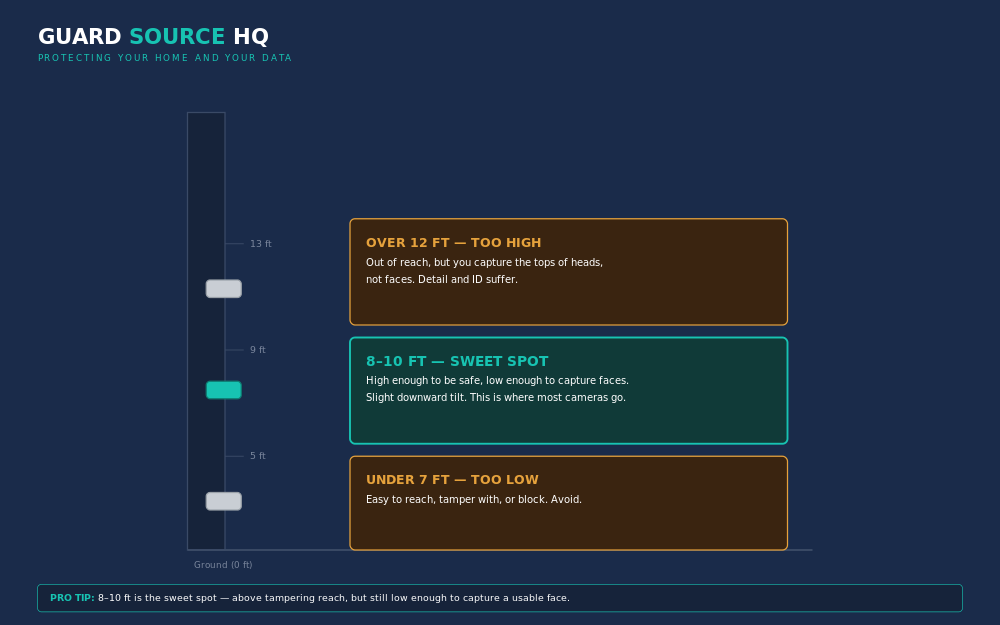
For most exterior security cameras, 8 to 10 feet is the right mounting height. Here’s why that range works:
It’s high enough to be out of easy reach. At 8 feet or more, a person can’t casually reach up to cover the lens, spray-paint it, yank it down, or knock it askew. That puts it above the reach of most people without a ladder or a tool, which defeats the simplest attacks on a camera.
It’s low enough to capture faces. This is the part people miss when they go higher “to be safe.” The higher you mount and the steeper you aim down, the more you see the top of a head and the less you see a face. At 8 to 10 feet with a proper shallow downward angle, you still capture identifiable faces of people at the distances that matter. Go much higher and your footage becomes useless for identification — you’ll know someone was there, but not who.
Why Too High Is a Real Problem
It’s tempting to mount cameras up at the peak of a two-story house, out of everyone’s reach. Resist it for your primary identification cameras. From way up high, a person approaching is foreshortened — you get scalp and shoulders, and the face only becomes visible if they happen to look up. Faces are how you identify people; a camera that can’t capture faces is documenting that something happened without telling you who did it. Save the high mounts for overview cameras whose job is wide-area coverage, not identification.
Why Too Low Is a Real Problem
Mounting at head height or just above feels right for face capture, but it creates worse problems. A reachable camera is a vulnerable camera — covered, sprayed, cut, stolen, or simply knocked out of aim by a passing shoulder or a thrown jacket. It’s also easier for someone to identify and avoid. Below about 8 feet, you’re trading durability and tamper-resistance for a marginal framing benefit you can achieve anyway with proper aim from a bit higher.
GuardSourceHQ Tip
Mount cameras 8–10 feet high — high enough to resist tampering, low enough to capture a usable face instead of the top of a head.
Heights for Specific Situations
Front Door / Entry Cameras
You want faces here above all. Mount around 8 to 9 feet, positioned slightly off to the side rather than directly overhead, angled to catch the face of someone standing at the door. A camera mounted right above the door pointing straight down gets the back of a head — useless. Off to the side and angled in is the move. (A dedicated video doorbell at a lower height complements this by catching faces up close.)
Driveway and Vehicle Cameras
8 to 10 feet works well. You want to capture both people and vehicle details (and ideally a license plate, if the camera and distance allow). Aim to cover the length of the driveway, and remember a wide camera covering the whole drive won’t read a plate at distance — that may need a second, narrower camera.
Overview / Wide-Area Cameras
For cameras whose job is broad coverage of a yard or open area rather than identifying faces, higher is fine — 10 to 12 feet or more gives a commanding wide view. Just don’t rely on these for identification; pair them with lower identification cameras at the key approach points.
Indoor Cameras
Mount in a high corner, typically 7 to 9 feet or near ceiling height, angled to cover the room and the entry path. High corners give the widest view and keep the camera out of reach. Keep cameras out of bedrooms and bathrooms for privacy.
Barn and Outbuilding Cameras
Inside large structures, a high corner mount covers the most floor area. Outdoors on a tall building, balance reach against face capture the same way — high enough to protect the camera, angled to still catch faces at the approach. See our guide on PoE cameras for barns and outbuildings.
Angle Matters as Much as Height
Height and angle work together. The goal at any height is a downward tilt shallow enough to frame a person from roughly the chest up as they approach — not so steep that you’re looking down at their scalp. When you mount, aim the camera using a live view on your phone or a monitor, position a person (or imagine one) at the distance you care about, and tilt until their face fills the frame at that point. Then lock every adjustment screw down hard, because a camera that’s only partly tightened will droop over the following months until it’s filming the ground.
Common Height Mistakes
- Mounting too high for identification. Peak-of-the-house mounts capture scalps, not faces. Keep ID cameras at 8–10 feet.
- Mounting too low. Below 8 feet invites tampering, theft, and knocked-out aim. Get it out of reach.
- Pointing straight down over a door. You get the back of a head. Mount to the side and angle in.
- Aiming too steeply. Even at the right height, too much downward tilt loses the face. Keep the angle shallow.
- Not locking the aim. Loose adjustment screws let the camera droop over time. Tighten everything fully.
The Bottom Line
For most cameras, mount at 8 to 10 feet — high enough to resist tampering and theft, low enough to capture identifiable faces with a proper shallow downward angle. Go higher only for wide-area overview cameras that aren’t meant to identify anyone, and pair those with lower identification cameras at your key approach points. Position entry cameras off to the side rather than straight overhead, aim to catch faces at the distance that matters, and lock the aim down tight. Get the height right and ordinary cameras capture exactly what you need; get it wrong and even great cameras give you footage you can’t use.
Frequently Asked Questions
How high should security cameras be mounted?
Most cameras belong at 8 to 10 feet — high enough to be out of easy reach and resist tampering, low enough to capture identifiable faces with a shallow downward angle. Only wide-area overview cameras should go higher.
Is it bad to mount a camera too high?
Yes, for identification cameras. From up high you capture the tops of heads and shoulders, not faces, so you learn that something happened but not who did it. Reserve high mounts for overview cameras and pair them with lower ID cameras.
How high should a front-door camera be?
Around 8 to 9 feet, positioned slightly off to the side rather than directly overhead, and angled to catch the face of someone at the door. A camera straight above the door only sees the back of a head.
What angle should a security camera be at?
Aim for a downward tilt shallow enough to frame a person from about the chest up as they approach — not so steep you’re looking at their scalp. Set it with a live view, then lock every adjustment screw so it doesn’t droop over time.
How high should indoor cameras be mounted?
Mount indoor cameras in a high corner, roughly 7 to 9 feet or near ceiling height, angled to cover the room and the entry path. High corners give the widest view and keep the camera out of reach. Keep cameras out of bedrooms and bathrooms.
Who runs Guard Source HQ
Guard Source HQ grew out of problems I’ve spent years solving for myself, friends, and family. I’ve moved five times, set up all kinds of security camera systems, and helped friends and family install and troubleshoot theirs. I’ve had my own router compromised through a smart device, and people now come to me or get sent my way when something online doesn’t look right or after they’ve been scammed. I built Guard Source HQ to turn what I’ve learned from solving those problems into guides and tools regular people can use.
Need help with something I haven’t covered? Ask a question or suggest a topic.